Orthodontic Treatment
Orthodontic Treatment
Who
Is an Orthodontist?
Orthodontists are dental professionals who,
after completing a five-year dental school program, have successfully completed
a 4–6 year orthodontic specialty or doctoral training program and conducted a
scientific thesis in the field of orthodontics. They are specialists in the
application of functional jaw orthopedics, extraoral appliances, and fixed
orthodontic (braces) treatments. Orthodontic treatments must be performed
exclusively by orthodontists.
The term orthodontics originates from
Latin, where “ortho” means straight and “donti” means tooth; therefore,
orthodontics literally means “straight teeth.”. Orthodontics is a branch of
dentistry concerned with the supervision, guidance, and correction of
dentofacial (jaw and facial) structures in growing or adult individuals. It
focuses on correcting irregularities by guiding tooth movement and modifying
the relationships between teeth, jaws, and facial bones through controlled
force application.
Scope of Orthodontics
1.
Diagnosis,
prevention, interception, and treatment of malocclusions.
2.
Design,
application, and monitoring of functional and corrective orthodontic
appliances.
3.
Guidance
of teeth and supporting tissues to achieve ideal functional, physiological, and
aesthetic relationships between facial and cranial structures.
Why Do Orthodontic Disorders Occur?
1.
Genetic factors:
In individuals with skeletal
discrepancies, missing teeth, maxillary constriction, or dental crowding, the
presence of similar anomalies in family members is significant.
2.
Ear, nose, and throat (ENT) problems:
Conditions such as nasal septum
deviation, adenoid hypertrophy, and mouth breathing can negatively affect jaw
development.
3.
Parafunctional habits:
Habits such as thumb sucking, cheek
sucking, prolonged pacifier use, and tongue sucking—if not discontinued in a
timely manner—can adversely affect jaw growth. Children with such habits should
be closely monitored, and the habits should be eliminated as early as possible.
4.
Early tooth loss:
Premature extraction of primary teeth
due to caries without the placement of space maintainers may cause adjacent
teeth to drift into the extraction space, leading to loss of space for the
erupting permanent teeth. This may result in crowding and eruption problems.
Common Orthodontic Disorders
Anterior
open bite:
A condition in which posterior teeth
are in contact while the upper and lower anterior teeth do not overlap, leaving
a vertical gap between them.
Crossbite:
Normally, upper teeth should overlap
the lower teeth. When this relationship is reversed, the condition is referred
to as a crossbite.
Crowding:
Insufficient
space within a dental arch or a specific region to allow proper alignment of
the teeth.
Spacing
(Diastema):
The presence of spaces between adjacent
teeth, most commonly observed between the maxillary central incisors. Diastema
is considered normal during the primary dentition stage.
Ectopic
eruption:
Abnormal
eruption of a tooth in a position other than its normal anatomical location.
Impacted
tooth:
A
tooth that fails to erupt and remains embedded within the jawbone, usually due
to lack of space.
Lip
incompetence:
Inability
of the lips to adequately cover the teeth when the mandible is in a relaxed
position.
Deep
bite:
In ideal occlusion, the maxillary
incisors should overlap the mandibular incisors by approximately 2–3 mm or
one-third of the crown height of the lower incisors. Excessive overlap is
referred to as a deep overbite.
Increased
overjet:
An
excessive horizontal distance between the maxillary and mandibular incisors
when the teeth are in occlusion.
Rotation:
A
condition in which a tooth is rotated around its long axis within the alveolar
socket.
Transposition:
A
positional anomaly in which two teeth erupt in each other’s normal positions.
Why Is Orthodontic Treatment Necessary?
Most patients seek orthodontic treatment
primarily to improve their facial appearance and smile aesthetics. Orthodontic
treatment enhances self-confidence by providing aesthetic benefits. However,
many orthodontic problems also have significant implications for oral health.
Crowded teeth are more difficult to clean, increasing the risk of dental caries
and periodontal disease. Malocclusions may cause abnormal tooth wear.
Orthodontic disorders can also lead to temporomandibular joint disorders, as
well as head and facial pain. Anterior open bite or spacing between anterior
teeth may impair proper sound articulation, resulting in speech difficulties.
Types of Orthodontic Treatments
Orthodontic
treatments are classified into four main categories:
1. Preventive
orthodontic treatments
2. Interceptive
orthodontic treatments
3. Corrective
orthodontic treatments
4. Retention
(stabilization) therapy
What Is the Ideal Age for Orthodontic Treatment?
In general, the ideal age for the
treatment of dental irregularities is between 10 and 12 years, when the
transition from primary to permanent dentition is nearly complete and the
eruption of canine teeth occurs. However, in cases involving jaw-related
problems and the elimination of harmful oral habits, early intervention is of
great importance. Therefore, an orthodontic examination is recommended around
6–7 years of age, when fissure sealants (protective materials applied to the
chewing surfaces of teeth to prevent caries) are typically placed.
Can Adults Receive Orthodontic Treatment?
Yes, adults can also undergo
orthodontic treatment comfortably. Contrary to common belief, teeth can be
moved at any age provided that the periodontal tissues are healthy. However,
since early-detected anomalies offer a wider range of treatment options, early
orthodontic evaluation of occlusion is highly recommended.
How Long Does Orthodontic Treatment Take?
Active orthodontic treatment typically
lasts approximately 1.5 to 2 years. However, the duration may vary depending on
the treatment modality, the patient’s age, and the level of patient compliance.
What Are Orthodontic Appliances?
The selection of orthodontic appliances
depends on the type of malocclusion and the individual’s growth pattern. For
this purpose, various removable and fixed appliances—applied intraorally and
extraorally—are used in cases with skeletal discrepancies. For minor tooth
movements, removable appliances may be sufficient. In cases without skeletal
problems and with dental crowding only, fixed orthodontic treatments are
generally preferred.
Fixed Orthodontic Treatment Options
Fixed orthodontic treatments are indicated
in cases where there is no skeletal discrepancy or where skeletal correction is
not feasible, but varying degrees of dental crowding are present. Fixed
orthodontic treatments (dental corrections) are initiated after the eruption of
all permanent teeth.
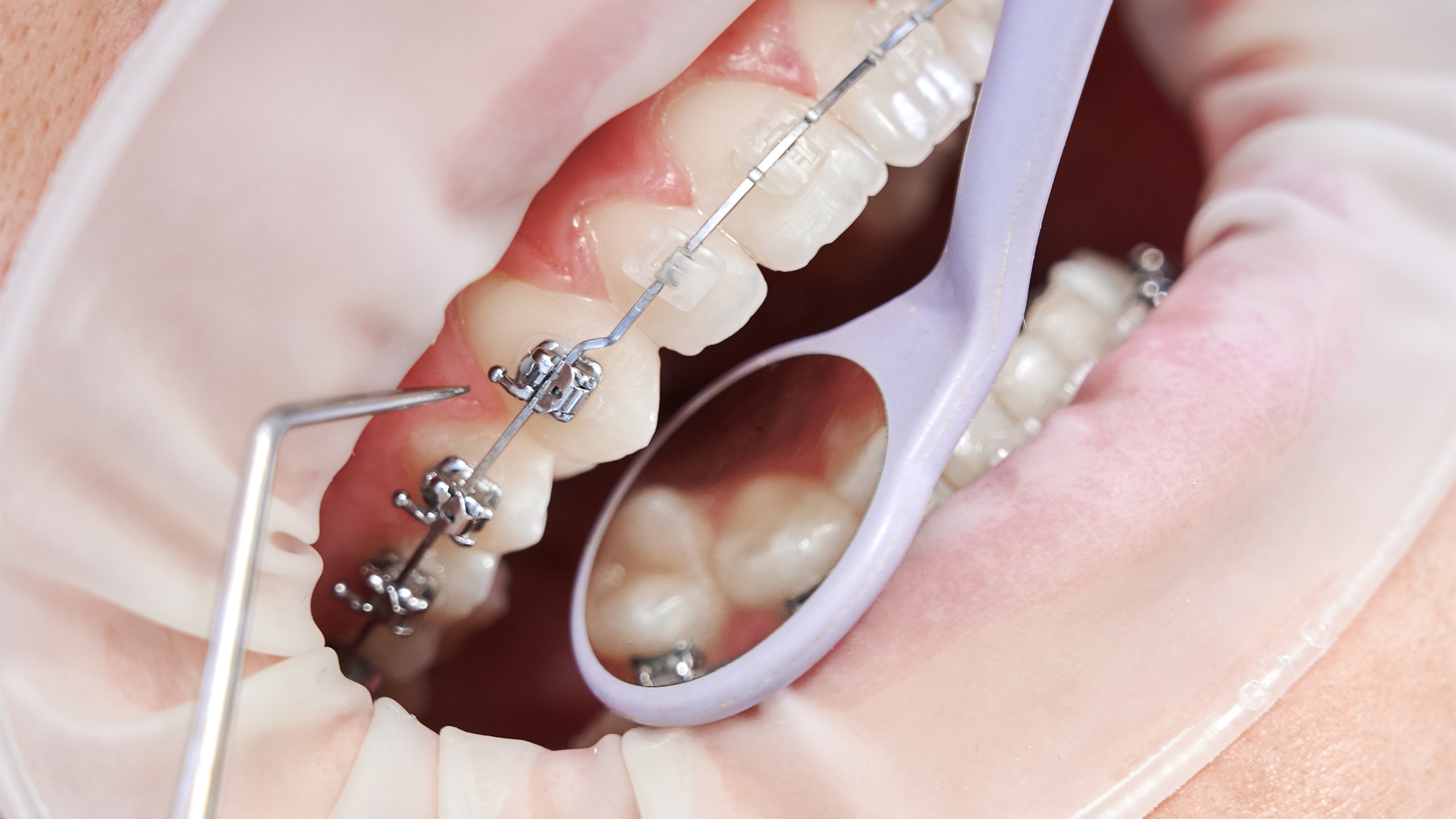
Brackets bonded to the teeth contain
slots into which highly elastic or pre-bent flexible archwires are placed and
ligated. These archwires guide the teeth toward their ideal positions. Springs
and elastics may also be used as part of fixed orthodontic treatment.
Aesthetic Brackets
Many adult patients are hesitant to
undergo orthodontic treatment due to the visible appearance of orthodontic
appliances. Some may choose tooth extraction or porcelain crowns, which involve
tooth reduction, as an alternative. However, orthodontic treatment preserves
the natural tooth structure and provides a more aesthetic and biologically
favorable outcome.
To address aesthetic concerns,
tooth-colored ceramic brackets are used instead of metal brackets. These
brackets have increased acceptance among adult patients, although their cost is
relatively higher.
Precautions During Fixed Orthodontic Treatment
During the first week, temporary sores
may develop on the inner cheeks, lips, or tongue. These usually resolve within
1–2 weeks as the patient adapts. Orthodontic wax may be used for protection.
Hard foods (such as green almonds,
plums, apples, carrots, nuts, and chips) should be avoided. Sticky foods (gum,
gummy candies) and carbonated beverages should not be consumed. Sandwiches and
similar foods should not be bitten into directly but broken into pieces.
These foods may cause bracket debonding
or wire breakage, leading to prolonged treatment duration.
Treatments with Removable Appliances
This
treatment approach is typically applied before permanent dentition, during the
primary or mixed dentition stages. The aim is to guide growth and development,
ensure proper eruption of teeth within the dental arches, and establish correct
dimensional relationships between the jaws.
Functional Appliances
Functional
appliances are used during growth and development to guide jaw growth in cases
of mandibular or maxillary deficiency or excess.
Extraoral Appliances
Appliances
such as chin cups and headgear provide external support to increase or restrict
jaw growth as required.
How Do Teeth Move During Orthodontic Treatment?
Orthodontic treatment is a biological
process, and orthodontic tooth movement is a physiological phenomenon. When
light, continuous pressure is applied to a tooth via fixed or removable
appliances, the tooth moves within the alveolar bone. Bone resorption occurs on
the pressure side, while new bone formation takes place on the opposite side.
This coordinated process is known as bone remodeling, allowing the tooth to stabilize
in its new position.
Who Is Not Suitable for Orthodontic Treatment?
Orthodontic appliances may not be
suitable in certain medical conditions. In patients with blood disorders such
as leukemia or hemophilia, special medical precautions are required prior to
extractions. Orthodontic wires may be problematic in patients with recurrent
aphthous ulcers. Orthodontic treatment options may also be limited in
individuals with intellectual disabilities.
Decision-Making for Tooth Extraction in Orthodontics
If there is insufficient space to
properly align the teeth, orthodontists may create space through tooth
extraction or alternative space-gaining methods. Orthodontic treatments may
therefore be extraction-based or non-extraction-based. The decision is made by
the orthodontist, with facial aesthetics being one of the most important considerations.
Extraction treatments may allow retrusion of the lips, while non-extraction
treatments may result in lip protrusion.
Retention Phase
After orthodontic treatment, teeth tend
to relapse to their original positions. To prevent this, teeth must be
maintained in their corrected positions until bone and surrounding tissues
fully adapt. Removable or fixed retainers are used for this purpose.
Removable retainers should be worn as
instructed, potentially from 3 months up to 2 years or longer.
Fixed retainers (lingual retainers)
consist of a thin wire bonded to the inner (lingual) surfaces of the teeth. The
duration of retention is determined by the orthodontist based on the initial
condition.
Orthognathic Surgery
Orthognathic surgery refers to surgical
procedures performed to correct jaw and facial skeletal discrepancies and
restore normal function. When developmental discrepancies of the jaws cannot be
adequately treated with orthodontics alone, orthognathic surgery may be
required. Depending on the condition, the jaws may be repositioned forward,
backward, vertically, or laterally.
Oral and Dental Care During Orthodontic Treatment
·
Teeth
should be brushed after every meal and snack.
·
Interdental
and bracket areas should be cleaned at least once daily.
·
A
fluoride mouth rinse should be used before bedtime.
·
Oral
irrigators are beneficial.
·
Regular
dental check-ups and orthodontic appointments must be maintained.
·
All
removable and functional appliances should be worn as prescribed.
·
Hard
and sticky foods should be avoided.
·
These
measures help prevent caries, reduce appliance damage, and enhance treatment
effectiveness.
Discomforts and Risks
·
Mild
pain is common at the beginning of treatment and usually subsides within 3–4
days.
·
Temporary
tooth mobility may occur and is normal.
·
Poor
oral hygiene may result in permanent stains, caries, and periodontal disease.
·
Rarely,
root resorption may occur.
·
Temporomandibular
joint discomfort may develop.
·
Growth
changes during or after treatment may positively or negatively affect outcomes.
Clear Aligner (Wire-Free) Orthodontic Treatment
With technologies such as Invisalign®,
clear aligners allow correction of dental crowding without traditional braces.
A series of custom-designed transparent aligners is changed every 1–2 weeks to
gradually move teeth into the desired position. Aligners are nearly invisible,
removable during meals, comfortable, and do not cause irritation. Suitability
is determined by the orthodontist.
Lingual Orthodontics (Hidden Braces)
In lingual orthodontics, brackets are
bonded to the inner (tongue-facing) surfaces of the teeth, making them
invisible externally. Due to the anatomical variability of lingual surfaces,
brackets are positioned using laboratory-based techniques and transferred using
custom trays.
Recent advances allow laser scanning
and fabrication of fully customized lingual brackets. Lingual orthodontics
requires greater precision and expertise and has both advantages and
limitations compared to conventional orthodontics.
- Veneer & Smile Design: Enhancing Your Smile with Precision
- Emax Crowns: A Guide to the Latest Dental Technology
- Zirconium Crowns
- Digital Smile Design: Enhancing Your Smile with Technology
- Hollywood Smile
- Tooth Diamond, Tattoo, and Dental Grillz: A Professional Guide
- Implant Treatments
- General Anaesthesia: A Professional Overview
- All-on-4 vs All-on-6 Implant Treatment Options: Which is Right for You?
- Jaw Tumor and Fracture: A Professional Overview
- Snoring Treatment
- Temporomandibular Joint Issues
- Surgical Procedures
- Bad Breath Treatment: Effective Solutions for Fresher Breath
- Dental Spa: A Professional Approach to Oral Health
- Teeth Grinding: Causes, Symptoms, and Treatment
- Periodontology (Gum) Treatments
- Gum Aesthetics – Pink Aesthetic
- Restorative Dentistry
- Inlay-Onlay Fillings: A Professional Guide
- Sensitive Dental Treatment: Tips for Managing Pain During Procedures
- Orthodontic Treatment
- Clear Aligners (Invisalign): The Transparent Alternative to Traditional Braces
- Endodontics: What You Need to Know About Root Canal Treatment
- Pedodontics (Pediatric Dentistry)
- Prosthetic Treatments in Dentistry: A Comprehensive Overview
- Teeth Whitening