What is Invisalign Treatment?
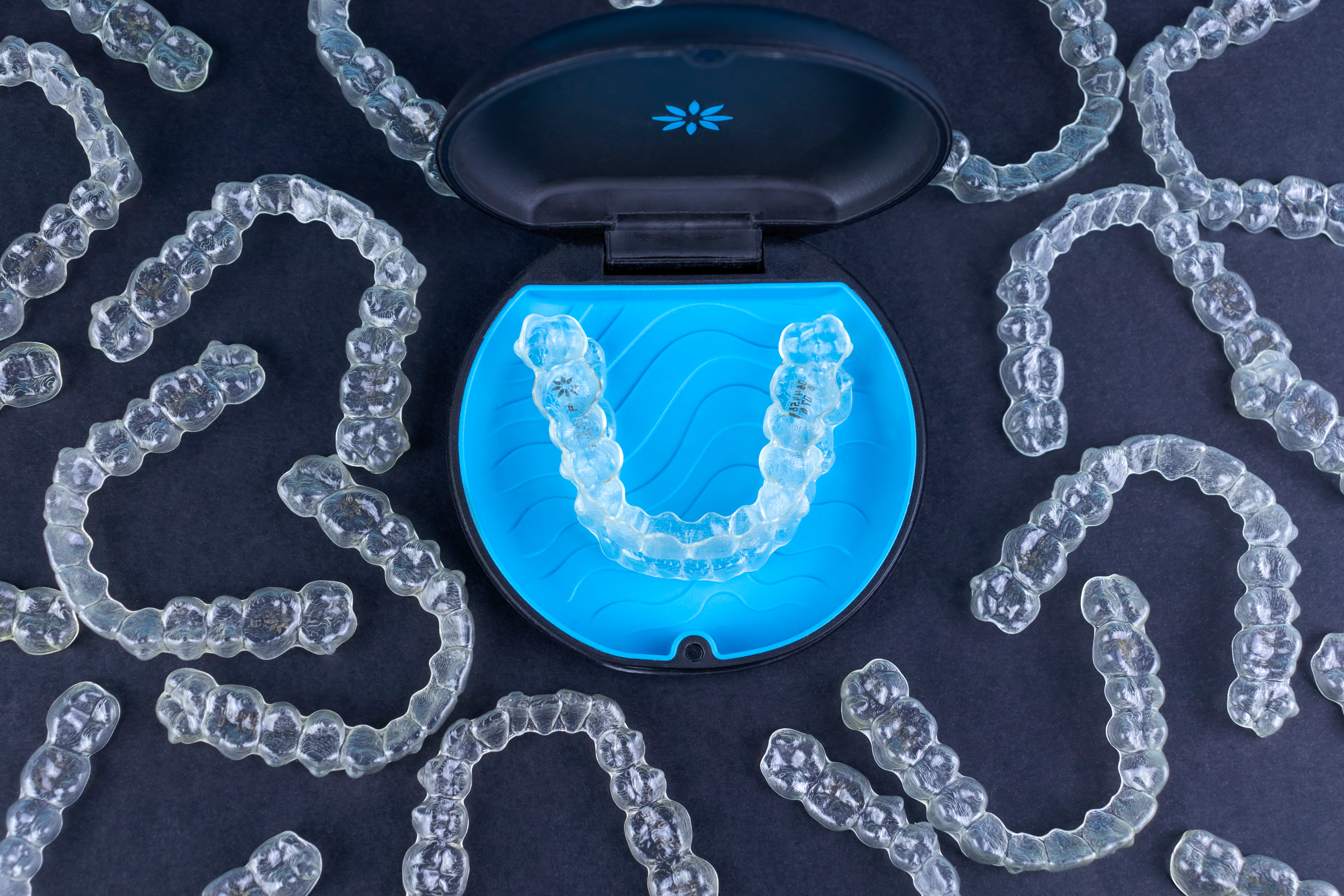
What is Invisalign Treatment?
Invisalign
treatment, also known as an orthodontic treatment system without conventional
braces, is a treatment method consisting of a series of nearly invisible,
removable clear aligners used to align the teeth. These aligners are
custom-made for each patient and gradually move the teeth into their ideal
positions over time. Compared to traditional braces, they are far less
noticeable.
Who
Is Eligible for Clear Aligner Treatment? Is There an Age Limit?
Clear
aligner treatment can be applied to individuals with healthy teeth and
surrounding oral tissues. While it is commonly used in adult patients, it can
also be applied to children starting from the ages of 7–8, depending on dental
development.
Can
Clear Aligner Treatment Be Applied to Patients with Dental Implants or Previous
Dental Treatments?
Since
dental implants are osseointegrated with the jawbone, they cannot be moved like
natural teeth. However, clear aligner treatment can be applied to patients with
dental implants if the treatment plan ensures that no orthodontic force is
applied to the implant and it remains stationary.
There
is no contraindication for patients who have previously undergone restorative
procedures such as fillings or root canal treatments.
Can
Clear Aligners Be Used in Patients with Severe Crowding?
Successful
outcomes can also be achieved in patients with severe dental crowding using
clear aligner therapy. In some cases where permanent tooth extraction is
planned due to excessive crowding, clear aligner treatment may be preferred
instead of conventional fixed orthodontic appliances.
How Does Invisalign Treatment Progress?
Before
starting Invisalign treatment, all existing dental caries must be treated and
dental calculus (tartar) must be removed. As with any orthodontic treatment, a
comprehensive clinical examination is performed, including intraoral
radiographs. Subsequently, a three-dimensional digital model (impression) of
your teeth is obtained and used to create a personalized treatment plan.
The
treatment plan prepared by your orthodontist—together with your intraoral scan
records, radiographs, and clinical photographs—is shared with the aligner
manufacturing company. A customized digital treatment simulation is then
created and submitted to your orthodontist for approval.
After
reviewing the simulation, your orthodontist may make the necessary
modifications. Once the treatment plan is finalized, the total number of
aligners and the estimated duration of the treatment are determined. Treatment
duration and the number of aligners vary from patient to patient depending on
the severity and nature of the initial orthodontic problem.
Before
giving final approval, your orthodontist may share the treatment simulation
with you so that you can discuss whether the projected outcome meets your
expectations. Once the final simulation is approved, the production of the
aligners begins. The aligners are typically delivered to your orthodontist
within approximately 3–4 weeks.
During
the first appointment, small tooth-colored attachments—referred to as
“attachments”—are usually bonded to the tooth surfaces. These attachments help
the aligners grip the teeth more effectively and enhance the efficiency of
tooth movement. If necessary, interproximal enamel reduction (IPR), also known
as stripping, may be performed. Your orthodontist will then provide you with
the appropriate number of aligners.
Follow-up
intervals with clear aligner therapy are generally longer compared to
conventional fixed orthodontic appliances. Monthly visits are often not
required, and follow-ups at intervals of approximately 2–3 months may be
sufficient.
To
support patients throughout their clear aligner treatment, the My Invisalign
application can be used to remind patients when to change aligners, monitor
daily wear time, inform the orthodontist, and track upcoming appointments.
Patients can also share progress photos with their orthodontist, family, or
friends. Based on the submitted photos, the orthodontist can monitor treatment
progress and provide feedback.
Interim
check-ups during clear aligner treatment may also be conducted as virtual
appointments. For this purpose, the Invisalign Virtual Care feature enables
orthodontists to remotely monitor their patients’ Invisalign treatment. Through
the My Invisalign app, patients can take and upload progress photos using their
mobile devices. When a patient submits photos at the time of an aligner change,
the orthodontist reviews them via the Invisalign Virtual Care platform to
assess whether the treatment is progressing according to plan and can provide
appropriate instructions.
If
live interaction is required to discuss treatment-related matters, a video
consultation can be scheduled through the Invisalign Virtual Care platform, or
the patient may be instructed to schedule an in-office appointment. This system
allows orthodontists to manage Invisalign treatments even for patients living
in different countries.
What
Should Patients Pay Attention to During Clear Aligner Treatment?
Aligners
should be changed strictly according to the schedule recommended by the
orthodontist and should not be replaced prematurely. The daily wearing time
should not be less than 20–21 hours. Eating and drinking hot beverages while
wearing the aligners should be avoided. Once the aligners are removed, patients
may eat and drink freely without dietary restrictions.
How
Should Clear Aligners Be Maintained?
Aligners
should be cleaned daily by brushing them under running lukewarm water. In
addition, denture cleaning tablets or special aligner cleaning gels may be
used.
How
Long Should the Aligners Be Worn?
Since
this treatment is customized for each individual, the total duration depends on
the daily wearing time and the specific condition of the teeth. Only the
treating orthodontist can determine the duration of the treatment process.
Does Invisalign Have Advantages Over Traditional Braces?
Invisalign
aligners are transparent, making them barely noticeable to others.
Maintaining
oral and dental hygiene is easier, as the aligners can be removed for normal
toothbrushing.
Because
teeth can be cleaned more effectively, the risk of dental caries is
significantly reduced.
Clear
aligners are more comfortable than traditional braces and do not irritate the
teeth or gums.
Fewer
in-office visits are required during Invisalign treatment, saving patients
time.
Additionally,
it is possible to digitally predict the final position of the teeth at the
beginning of treatment.
Seeing
the expected treatment outcome from the start enhances patient motivation.
Can
Any Dentist Perform Invisalign Treatment?
This
treatment must be performed by an orthodontist who has completed the required
Invisalign certification.
What Happens After the Active Treatment Phase Is Completed?
After
the completion of active orthodontic treatment, retention therapy is required
to maintain the achieved tooth positions and prevent relapse. Retention
aligners or lingual retainers should be used for this purpose. During this phase,
follow-up visits may be scheduled every six months.