The All-On-Four Treatment
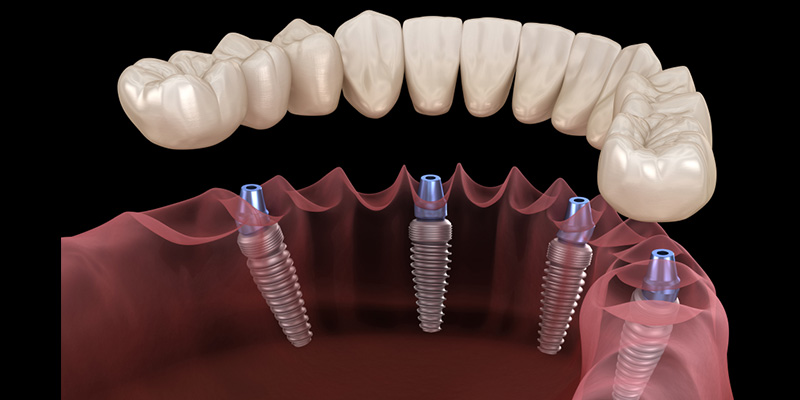
The All-On-Four Treatment
Tooth
loss may occur due to various reasons, and in cases where multiple teeth are
missing, implant-supported prostheses represent an important treatment option.
Prolonged edentulism may lead to resorption of the jawbone, which in some
patients necessitates advanced surgical procedures or bone grafting. Such
additional interventions may increase treatment costs and prolong the overall
treatment duration.
The
All-on-4 technique is a treatment concept that allows for a more biological and
practical approach, particularly in patients with complete edentulism or
advanced tooth loss, by preserving the existing bone structure. In this
technique, the anterior region—where bone volume is typically most favorable—is
utilized, with two implants placed vertically and two implants placed at an
angle in the posterior regions. In this way, a fixed prosthesis can often be
planned on just four implants without the need for advanced bone surgery. In
suitable cases, a temporary fixed prosthesis can be delivered on the same day
as implant placement, enabling rapid restoration of chewing function, speech,
and aesthetics. The uninterrupted progression of the treatment significantly
enhances the patient’s social comfort and quality of life.
Compared
to removable complete dentures, All-on-4 treatment provides greater stability
during mastication and offers patients a more secure and confident user
experience, independent of denture retention. The functional load transmitted
to the jawbone via the implants helps prevent further bone loss associated with
prolonged disuse. This method also serves as an important alternative for
patients who have difficulty tolerating removable dentures due to a pronounced
gag reflex. Current clinical studies demonstrate high long-term success rates
of All-on-4 treatment when applied to appropriately selected patients by
experienced clinicians.
All-on-4
is not a standardized procedure applied identically to every patient; rather,
it is an individualized treatment model determined after detailed clinical and
radiological evaluation. Factors such as bone volume, general health status,
occlusal relationship, and oral hygiene play a decisive role in treatment
success. Therefore, the treatment plan must be tailored to each individual and
followed closely by an experienced dental team.